



SHENGFA: Your Professional Fancy Yarn Supplier!
Jiaxing Shengfa Trading Co., Ltd. is a comprehensive textile enterprise that integrates research, development, production, and sales. With over ten years of professional experience, we are dedicated to the production of warping heads, providing efficient warping solutions for our customers. The company currently employs over 100 individuals, including professional technical personnel and an experienced production team.
Our Advantages
Innovation-Based Product
We focus on innovation to meet diverse customer needs. Our main products include processing warping heads, well-warped heads, composite yarns, bright yarns, semi-dull yarns, polyester mother yarns, nylon mother yarns, and specialty yarns.
Customized Services Available
As a customer-oriented enterprise, we provide customized services for various textiles, composite yarn raw materials, and warping heads. We also assist customers in sourcing various textile products domestically, providing comprehensive solutions.
Extensive Sales Market
With excellent quality and excellent service, our products are exported to Germany, Europe, the United States, Singapore, South Korea, the Middle East, South America, and other countries and regions.
24-Hour Service
Our professional team can analyze and take samples based on the samples provided by customers to provide high-quality references. We can quickly solve any problems customers encounter.


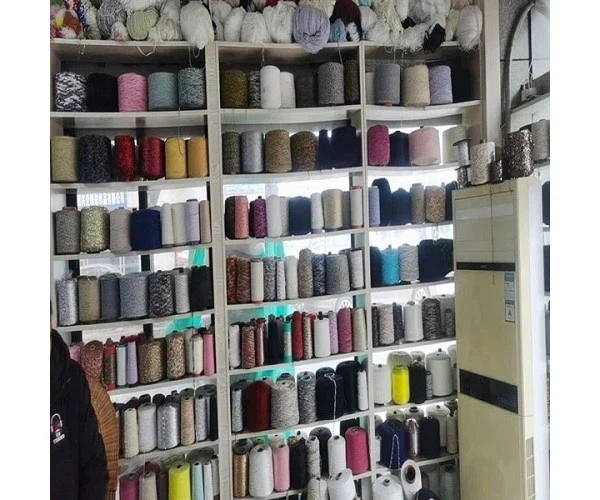
“Fancy yarns” are those in which some deliberate decorative discontinuity or interruption is introduced, of either color or shape or both color and shape. This discontinuity is integrated to produce an enhanced aesthetic effect.
Common Types of Fancy Yarns
Marl Yarn
A marl yarn is the most basic of the fancy effects, consisting of two yarns of the same count and twist but different colours or textures folded together to form a balanced yarn. A typical use of marl yarns is men’s suiting fabric to create a pinstripe effect.
Spiral or Corkscrew Yarn
A plied yarn is a type of fancy yarn with the distinctive smooth spiralling of one yarn component around the other. It looks a lot like marled yarn except here spiral yarn is overfed on one yarn. It can be manufactured using a doubling frame or the ring spinning system.
Gimp Yarn
A gimp yarn is made up of three component yarns: the core, the effect, and the binder, and is manufactured in two stages. The core and the effect, which is usually overfed, are twisted together in the first stage, producing an intermediate yarn that resembles a spiral. The intermediate yarn is twisted together with the binder yarn in the second stage in the opposite direction of the twist used in the first stage. A gimp yarn is made up of a twisted core and an effect yarn wrapped around it to create wavy projections on the surface.
Diamond Yarn
A diamond yarn is made by wrapping a coarse single yarn or roving with two fine yarn or filament components of contrasting colour, one in the direction of S twist and the other in the direction of Z twist. By extending and varying this technique, you can create multi-fold or 'cabled' yarns with a variety of effects.
Boucle Yarn
This yarn is distinguished by a tight loop that protrudes from the body of the yarn at fairly regular intervals. These yarns are made up of three different yarns. The three parts of yarn are the core, the effect, and the tie or binder. The effect yarn is looped around a core or base yarn. To keep the loops in place, the third ply (binder) is wrapped over the effect ply. So, it is known as boucle yarn.
Loop Yarn
The loop forming thread in this yarn creates prominent loops or circular ring shapes along the length of the yarn. Loop yarns are distinguished by the effect yarn's circular projections. They are usually made up of at least four component yarns: two cores, an effect, and a binder.
Snarl Yarn
This is similar to loop yarn, except the looping yarn has a high twist, causing the loop to snarl. The loops created by the effect yarn fall under the influence of the untwisting stress in the yarn and form kinks due to the twist liveliness. The required snarl size and frequency can be obtained by carefully controlling the details of overfeeding and spinning tension, as well as the level of twist in the effect yarn.
Knop Yarn
A knop yarn has prominent bunches of one or more of its component threads spaced at regular or irregular intervals along its length. It is typically produced using a machine with two pairs of rollers, each of which can be operated independently. One thread is delivered intermittently, while the other is delivered continuously. These bunches are formed when the excess effect yarn wraps around the core yarn at the same point. The yarn looks like a regular plied yarn between the knop sections. When using other yarns, the effect yarn overfeed is constant during production; when using knop yarns, the overfeed is controlled. The formation of the knop can be controlled by a device called knopping bar or a control bar.
Advantages of Fancy Yarn
Gorgeous in Appearance
The fancy yarn fabric is gorgeous in appearance, colorful in color, gorgeous and elegant, and very decorative, and can catch the consumer’s attention at the first time.
Diversified
Fancy yarn fabric is a diversified and sexualized product, which satisfies the consumption psychology of modern urban people in pursuit of fashion and individuality.
Easy to Design
Fancy yarn fabric is easy to design, because the change of yarn shape directly affects the appearance of the fabric, so only need to improve the selected yarn, you can show a variety of changes in the fabric, casual and ingenious.
Less Post-Processing
Post-processing such as printing and dyeing is not required or rarely required for the production of fancy yarn fabrics. The process is short and the production is simple. The products are also sold very well, so they are very popular among manufacturers.
Application of Fancy Yarn
Homewares:
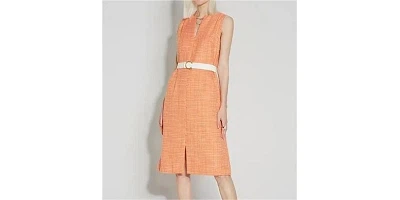
Upholstery and home furnishings have offered a relatively new field to spinners of fancy yarns over the past 20 years. The now surprisingly long-lived trend for ‘shabby chic’ furnishing fabrics favors the use of fabrics involving fancy yarns, because the inherently uneven surface of a fancy yarn is enhanced when it is woven or knitted into a fabric, giving that fabric itself a broken surface. In addition to drapes and upholstery – which are expected to have a certain durability – fancy yarns have been used lavishly in accessories such as cushions and throws. Furthermore, as textural details have become an important part of interior design, an additional application for all fancy yarns has been found in making tassels and braids for furnishings and drapes.
Fashion:
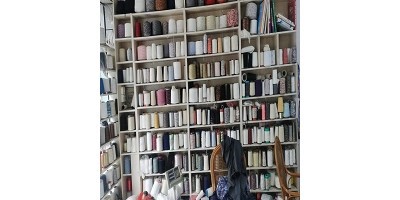
Fancy yarns have wide-ranging application in apparel at all levels of the market. Where once the extreme complexity and difficulty of making and using fancy yarns inhibited their production in sufficient quantity or at a low enough price for the mass market, improved process control has now greatly extended their market penetration. In particular, fancy yarns have become an increasingly prominent part of the revived hand knitting market.
Tips for Handling Fancy Yarn
Working with fancy yarn requires some considerations to ensure optimal results:
Pattern Selection
Choose patterns that complement the unique characteristics of fancy yarn, such as open stitch patterns or designs that allow the yarn's texture and color variations to shine.
Needle and Hook Size
Experiment with different needle or hook sizes to achieve the desired fabric density and drape. Some fancy yarns may require larger needles or hooks to accommodate their bulkiness or textured elements.
Caution in Washing
Follow the recommended care instructions for fancy yarn, as some types may be delicate or prone to snagging. Handwashing or using a gentle cycle in cold water is often recommended.
Combine with Basic Yarn
Consider combining fancy yarn with a basic yarn to create interesting textures and visual contrast. This can help balance out the fancy yarn's unique characteristics and make it easier to work with.
Factors to Consider Before Choosing Fancy Yarns
Weight
Find a yarn that’s a comparable weight to what’s called for in the pattern. If the pattern yarn is a worsted, find another worsted; if it’s a fingering, find another fingering. If the pattern doesn’t say a weight but only lists a particular yarn, look up the yarn specified in the pattern to find out more about it. What words like “worsted” and “fingering” mean can vary a lot in practice, so it can be helpful to check the suggested gauge of the yarn.
Fibre Characteristics
Find a yarn with similar fibre content to the yarn used in your pattern. Think about the properties of each fibre rather than trying to exactly match the content. If you want to use fibres with different characteristics than what the designer used, consider what impact that will have on your fabric.
Construction
Find a yarn that has a similar construction to the one called for in your pattern. Spinning preparation, like woolen or worsted spun, number of plies, and tightness of twist can all make a big difference. If the pattern calls for a chain- construction alpaca blend, don’t try a 3-ply alpaca yarn just because the weight and fibre are the same unless you really want more drape and less elasticity.
Swatch
Once you’ve found a candidate yarn (or perhaps a few candidates), make a large swatch (at least 6 in/15 cm square) in the stitch pattern called for in the pattern and using the needles you expect to use for the project. If the project is in the round, work your swatch in the round. If it’s flat, work a flat swatch. Then wash your swatch and let it dry before evaluating it. If it wants to curl or if it needs to be stretched (like lace), pin it to flatten or open it up.
Evaluate Your Swatch
Measure the number of stitches and rows in 4 in/10 cm of fabric. Do this in several places around your swatch to get an accurate measurement. Because your swatch is 6 in/15 cm square, you should always have some space on the edges that you’re not measuring because those edges can be get skewed and mess up your result. Make another swatch in a different yarn. Making many swatches can be the key to a successful project. Even if you’re pleased with your first one, maybe work up another swatch in a different yarn so you can compare the two.
Label Your Swatch
Label and keep every swatch. I tend to just write this info on the yarn label and then tie it to one of my swatch tails. Be sure to list exactly which needles you used, not just size, but brand and style too since the needle material and pointy-ness of the tips can make a big difference in gauge. Next time you’re thinking of making something, you can pull out your old swatches for inspiration. You may even have one already done that would work for that next project!
Ultimate FAQ Guide to Fancy Yarn
As one of the leading fancy yarn manufacturers and suppliers in China, we warmly welcome you to wholesale high-grade fancy yarn from our factory. All customized products are with high quality and competitive price.
Fancy Yarn, Fancy Yarn for Women s Fashion, Stretch Highly Oriented Yarn